Meeting the Moment: Scott Stephenson on Innovation, Accountability, and the Future of Insurance
Innovation in insurance isn’t new, but the pace, scale, and stakes have changed dramatically. As AI and automation reshape how decisions are made, leaders are being asked to move faster while maintaining the reliability and trust the industry depends on.
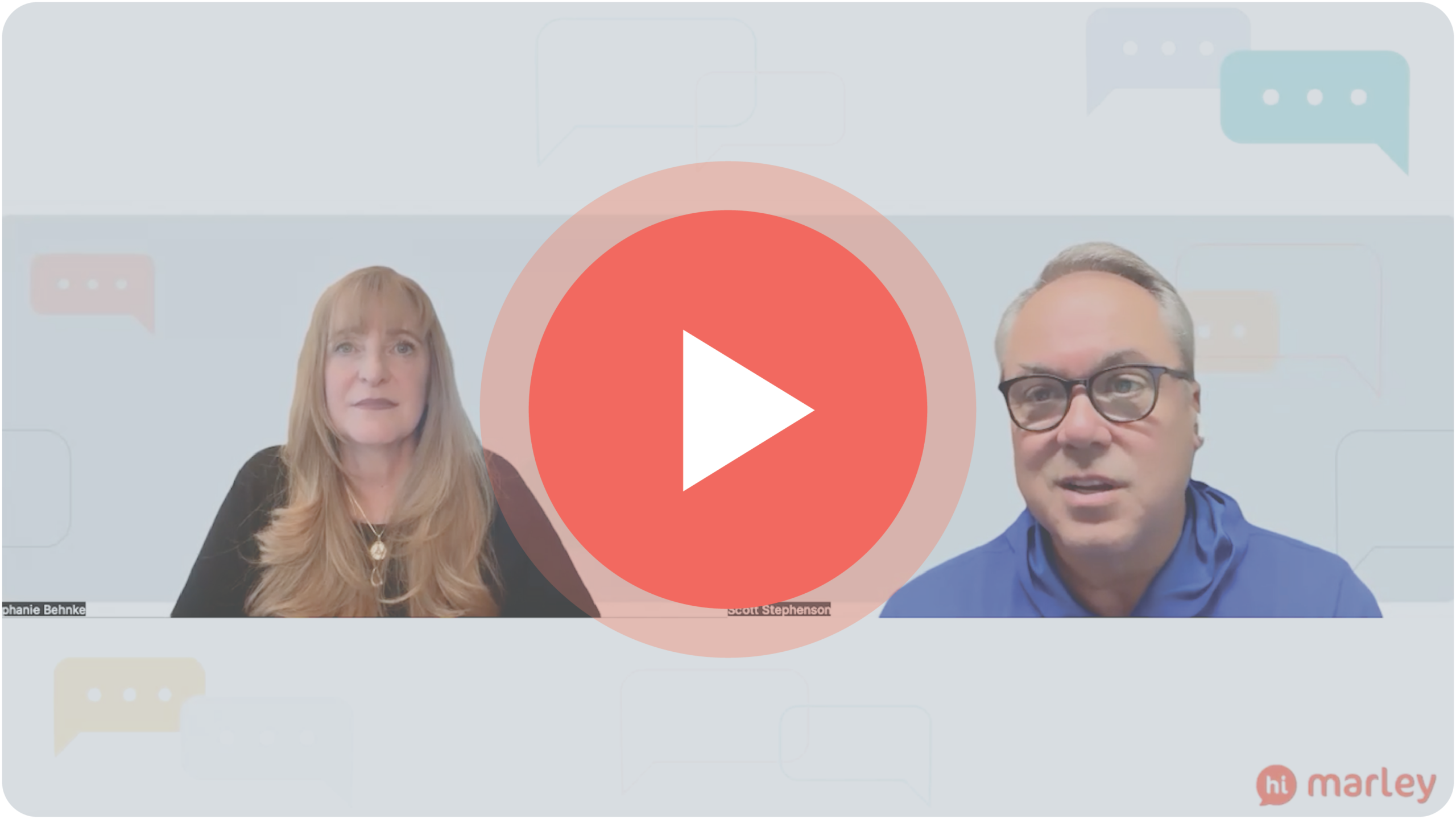
In this episode of Conversations that Connect, Stephanie Behnke sits down with Scott Stephenson, former President, CEO, and Chairman of Verisk and a recent addition to Hi Marley’s Board of Directors. He has extensive experience in high-growth companies and a unique point of view on how data science and AI should be applied in the P&C insurance industry.
Stephanie and Scott discuss some fundamental shifts underway in the industry and how leaders can navigate them with clarity, accountability, and purpose.
Insurance as an “Information Factory”
At its core, Scott believes insurance is an information business.
“Think of an insurance company as an information factory,” he explains. “You’re receiving signals, interpreting them, making decisions, and acting on them.”
What’s changed is the power and speed of the tools available to do that work.
Advances in AI, particularly generative AI, are enabling insurers to better understand risk, segment it, price it, and manage outcomes across the lifecycle. Historically, companies that improved these capabilities were able to differentiate and outperform. Today, that opportunity is even more pronounced.
“These new methods can drive a lot more precision and efficiency,” Scott notes. “But they also introduce new kinds of risk, especially if you don’t fully understand how they’re operating within your system. Industry executives need to figure out how to strike the balance between going fast and becoming highly automated but doing it in a way that is not only differentiated, but also secure.”
When Speed Becomes the Challenge
Stephanie recalls past changes in claims operations that introduced earlier, smaller settlements. While effective in isolation, they had unintended ripple effects across actuarial models, changing frequency and severity assumptions in ways that took time to fully understand.
That change happened one adjuster at a time. But today, similar decisions can be applied across thousands of transactions instantly.
“The amplification is real,” Stephanie notes. “And it changes how we need to think about decision-making.”
Scott agrees. While anticipating downstream impact has always been part of the job, AI compresses the feedback loop and raises the stakes.
“In the past, you could bring people together, align on a process, and manage change through shared context,” he says. “Now, decision rules may be embedded in systems that are learning and evolving as they operate.”
That shift requires leaders to stay closer to how decisions are made and how they evolve over time.
A New Level of Leadership Involvement
One of the most significant changes is who owns innovation.
Traditionally, transformation followed a linear path: business leaders defined requirements, technology teams translated them, and developers built the solution. The process could take months before leaders saw results.
Today, that window has compressed significantly.
This creates new expectations: business leaders can provide iterative prompting and feedback in real time, shaping outcomes and enabling faster results.
Innovation no longer depends entirely on IT or transformation teams. It becomes a shared responsibility across business, technology, and executive leadership.
As Capabilities Expand, so Does the Need for Focus
In this new environment, Scott emphasizes the importance of being clear about where you differentiate.
“What is core to your business? What is so central that you need to own it?” he asks. “And where does it make sense to partner?”
That clarity influences everything from technology strategy to talent investment. It also shapes how organizations think about their future.
“The essential nature of what an insurance company is will evolve over the next few years,” he says. “And leaders need to be in the middle of that.”
Leading Through the Shift
So, what does leadership look like in this environment?
In Scott’s view, leaders should be hands-on with these technologies, experimenting, learning, and “showing their work” to their teams. That signals how central it is to the business.
It also requires rethinking how success is measured. As automation expands, leaders need to ensure they are tracking the right signals, whether that’s the effectiveness of automated workflows, improvements in decision quality, or the impact on customer outcomes.
Finally, it’s about looking ahead. Even without perfect clarity, leaders should begin to articulate what their organizations might look like in a few years, how work will change, how roles will evolve, and where human expertise will matter most.
The Opportunity Ahead
“Insurance is no longer just about managing risk. It’s about leveraging data, automation, and intelligence to make better decisions at scale. You can observe pretty much the whole economy through the insurance mechanism.”
In this new environment, the path forward isn’t just about adopting new tools. It’s about staying close to the decisions those tools enable, being clear about where to differentiate, and guiding organizations through a period of meaningful change.
Watch the Full Episode